I have a habit — every time I travel abroad to meet clients, I find a café near my hotel in the morning, order a pour-over, and sit for half an hour. Not to be pretentious, but because I genuinely need that coffee to beat jet lag.
But in the past two years, I’ve noticed a shift: clients increasingly say “come to my office, I just got a new pour-over set” instead of “let’s meet at the café downstairs.”
Café Prices Go Up, Consumers Vote With Their Feet
This July, Barista Magazine ran a story with a straightforward headline: “Coffee Prices Are Up, But More Consumers Are Buying Whole-Bean Coffee Than Ever Before.” The numbers are striking:
- France: whole-bean coffee sales up 35% year-over-year
- Italy: up 33%
- Germany: up 31.2% — and in Germany, whole beans have overtaken traditional pre-ground coffee as the #1 category
- UK: up over 20%
In the US, the U.S. Chamber of Commerce reports that 57% of adults aged 25-39 drink coffee daily, and a growing number brew at home. Cold brew consumption has grown 50% since 2020, driven by Gen Z.
The reason is simple: cafés have become expensive. The average 16oz iced latte in the US is now $5.59, and matcha lattes cost even more. Europe is similar. Consumers did the math: a good pour-over kettle plus a few bags of specialty beans pays for itself in three months.
But It’s Not Just About Saving Money
Rising Trends keyword data is interesting: “specialty coffee” gets 49,500 monthly searches, up 22% year-over-year. “Coffee cupping” gets 14,800 monthly searches, also up 22%.
What does this mean? Consumers aren’t “trading down” — they’re “trading up,” from passively accepting a café’s output to actively controlling the entire brewing process.
I have a French client who used to talk orders the moment we met. Now he spends the first half hour talking coffee: recently tried Ethiopian Yirgacheffe, V60 or Kalita, what water temperature, how many clicks on the grinder. “This is way more interesting than scrolling my phone,” he says.
Matcha’s rise is also worth noting. Kerry’s 2026 Taste Charts place lavender in the “New” tier for tea and coffee, and European consumers are increasingly open to botanical flavors like lavender and blackcurrant. In the US, matcha now averages a higher price than latte, mocha, chai, and cold brew — the clearest premium anchor on the menu.
What This Means for Product Development
After years exporting kitchenware and glassware, I can feel the shift in inquiries:
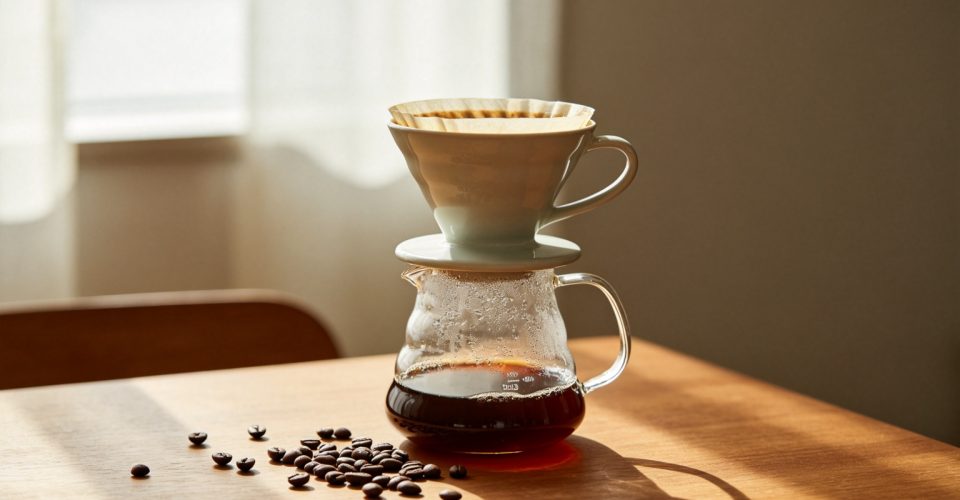
1. Pour-over equipment demand is surging. Glass sharing pots, stainless steel gooseneck kettles, ceramic drippers — once niche, now regular restock items for European clients.
2. Portability matters. “Pour-over sets you can bring to the office,” “collapsible drippers for travel” — slow travel and home coffee are converging.
3. Material and aesthetics are equally important. Soft neutrals like Pantone’s Cloud Dancer are especially popular in coffee gear. Consumers want something that “looks good on the kitchen counter and feels good to use.”
4. Tea is going specialty too. Not tea bags — loose leaf, cold brew, teas with origin stories. European clients are starting to ask, “Do you have teas with flavor profiles, like coffee?”
Closing Thought
When I travel now, I always pack a small collapsible dripper and some pour-over bags in my suitcase. It’s not that hotel coffee is undrinkable — it’s that those ten minutes of boiling water, grinding beans, and waiting for the drip have become a small ritual in a strange city.
Coffee is shifting from “buying a cup” to “making a cup.” For us product people, this shift is both an opportunity and a reminder: consumers don’t just want a tool — they want a controllable, textured everyday ritual.